
- >
- Blog >
- Do You Need Progesterone With Estriol...

If you have been prescribed vaginal oestrogen, you may be wondering whether you also need progesterone, particularly if you still have your womb or are already using HRT.
For most people, low-dose vaginal oestrogen does not require additional progesterone. However, this is different from systemic oestrogen HRT, such as patches, gel or tablets, where progesterone or another form of progestogen is usually needed if you still have a womb.
Understanding the difference can help you use your treatment safely and avoid making changes to your HRT without appropriate advice.
What are estriol cream and Vagifem used for?
Estriol cream (0.01% and 0.1%) and Vagifem are forms of local vaginal oestrogen. They are used to relieve symptoms associated with reduced oestrogen levels during and after menopause, including:
- Vaginal dryness
- Burning, itching or irritation
- Vaginal soreness
- Discomfort or pain during sex
- Reduced lubrication
- Some urinary symptoms associated with menopause
Vagifem contains estradiol and is supplied as a vaginal tablet. Estriol cream contains estriol and is applied inside the vagina.
Both treatments work mainly in the vaginal tissues rather than providing oestrogen throughout the body.
Do you need progesterone with Vagifem or estriol cream?
Usually, no.
Low-dose vaginal oestrogen is absorbed mainly in the vaginal tissues, with only a small amount entering the bloodstream. Because of this, additional progesterone is not usually required to protect the womb lining.
This applies to low-dose vaginal oestrogen products such as:
- Vagifem vaginal tablets
- Estriol vaginal cream
- Other low-dose vaginal oestrogen tablets, pessaries, gels and rings
NHS guidance confirms that vaginal oestrogen can generally be used without a progestogen, even if you still have your womb.
Why is progesterone needed with some HRT but not vaginal oestrogen?
The key difference is where the oestrogen works and how much reaches the rest of the body.
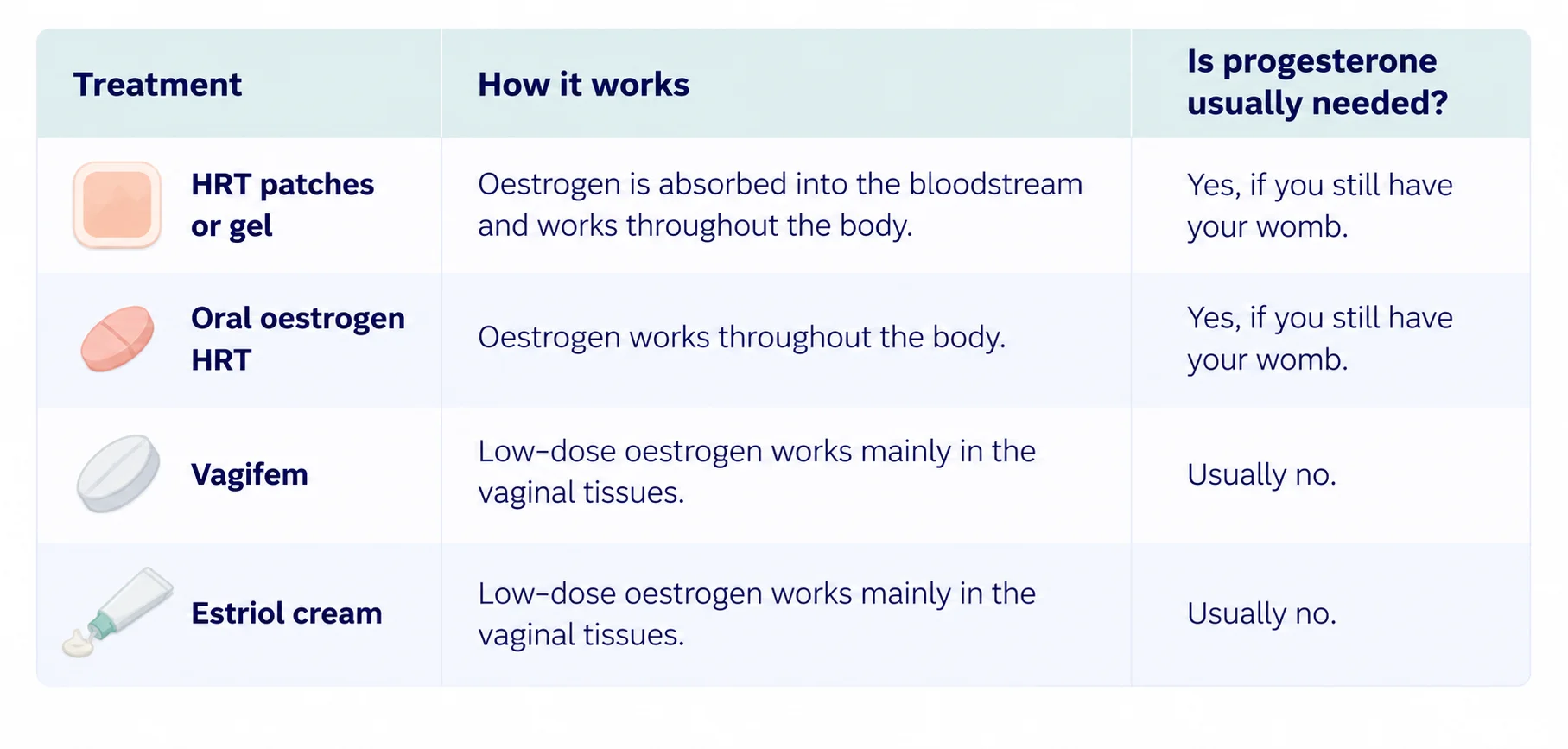
Systemic oestrogen can stimulate the womb lining. Progesterone, or another suitable progestogen, is used to provide endometrial protection and reduce the risk of the lining becoming too thick.
Low-dose vaginal oestrogen does not generally produce the same level of stimulation, so additional progesterone is not normally required.
What if you are already using HRT patches or gel?
If you are using systemic HRT, such as an oestrogen patch or gel, and still have vaginal symptoms, vaginal oestrogen may be added.
In this situation:
- You should continue taking your prescribed progesterone or progestogen alongside systemic HRT if you still have your womb.
- Vaginal oestrogen does not replace the progesterone required for systemic HRT.
- You do not usually need an extra dose of progesterone simply because vaginal oestrogen has been added.
For example, if you use an oestrogen patch with micronised progesterone, you should continue your prescribed progesterone regimen unless your healthcare professional advises otherwise.
Does it matter if you still have your womb?
Yes, but the answer depends on the type of oestrogen treatment.
If you are using only low-dose vaginal oestrogen
You will usually not need additional progesterone, even if you still have your womb.
If you are using systemic oestrogen HRT
If you still have your womb, you will usually need progesterone or another suitable progestogen to protect the womb lining.
If you have had a total hysterectomy
You will usually not need progesterone with systemic oestrogen HRT because there is no womb lining to protect. However, individual circumstances may differ, so your prescribed HRT should not be changed without medical advice.
What does the research and guidance say?
NICE recommends vaginal oestrogen for genitourinary symptoms associated with menopause and states that it can be used alone or alongside non-hormonal moisturisers and lubricants.
NHS guidance confirms that little vaginal oestrogen enters the rest of the body, meaning a progestogen is not usually required.
British Menopause Society guidance also states that low-dose vaginal oestrogen does not require additional systemic progestogen for endometrial protection. This is different from systemic HRT, where the dose and duration of progestogen must be appropriate for the amount of oestrogen being used.
Can vaginal oestrogen affect the womb lining?
At licensed low doses, vaginal oestrogen is not generally associated with significant stimulation of the womb lining.
However, you should seek medical advice if you experience:
- New or unexplained vaginal bleeding
- Persistent bleeding after starting treatment
- Unusual pelvic pain
- Symptoms that are worsening rather than improving
Any unexplained vaginal bleeding should be assessed, particularly after menopause.
Is vaginal oestrogen safe for everyone?
Although vaginal oestrogen is low dose and mainly local, it is still a prescription treatment and may not be suitable for everyone.
Speak to your healthcare professional before starting treatment if you:
- Have had breast cancer or another oestrogen-sensitive cancer
- Are taking an aromatase inhibitor
- Have unexplained vaginal bleeding
- Have a history of blood clots
- Have liver disease
- Are pregnant or think you may be pregnant
- If you have a history of breast cancer, particularly if you are taking an aromatase inhibitor, vaginal oestrogen should be considered with appropriate specialist input.
Important Information
Low-dose vaginal oestrogen, including Vagifem and estriol cream, usually does not require additional progesterone even if you still have your womb.
However, if you are also using systemic HRT, such as oestrogen patches or gel, you must continue using the prescribed progesterone or progestogen needed to protect your womb lining.
Vaginal oestrogen does not replace the progesterone required with systemic HRT, and you should not change or stop your prescribed HRT without medical advice.
If you are unsure whether you need progesterone with your vaginal oestrogen or existing HRT, you can complete our online assessment form or message the Pharmulous team to explore your treatment options.
References
- NICE. Menopause: diagnosis and management. NICE guideline NG23.
- NHS. About vaginal oestrogen.
- NHS. Treatment for menopause and perimenopause.
- NHS. About oestrogen tablets, patches, gel and spray.
- NHS. About Utrogestan.
- NHS Somerset Integrated Care Board. Genitourinary Syndrome of the Menopause. Dr Juliet Balfour, 12 November 2024.
- British Menopause Society. Progestogens and endometrial protection. Tools for Clinicians.
- British Menopause Society. Genitourinary Syndrome of Menopause: consensus guidance.
- Electronic Medicines Compendium. Vagifem 10 micrograms vaginal tablets: Summary of Product Characteristics.
- Danan ER, et al. Hormonal Treatments and Vaginal Moisturizers for Genitourinary Syndrome of Menopause: A Systematic Review. Annals of Internal Medicine. 2024;177(10):1400–1414.
Check out similar articles

Dr Amel Imam - 2nd October 2026
Switching From Mounjaro or Wegovy Injections to Wegovy Tablets:...

Dr Amel Imam - 30th September 2026
Is 8 Hours of Sleep Really Necessary? New Research on REM, Deep...

Dr Amel Imam - 30th September 2026
Can You Use Vaginal Oestrogen Long Term?

Dr Amel Imam - 29th September 2026
Vagifem Not Working Yet? When Should Symptoms Improve?

Dr Amel Imam - 29th September 2026
How Often Should I Weigh Myself? A Guide for Mounjaro, Wegovy...

Dr Amel Imam - 28th September 2026

