
- Home Page >
- Health Hub >
- Retatrutide UK: Weight Loss Results,...
Retatrutide UK: Weight Loss Results, Side Effects & Availability

Could retatrutide be the next big development in medical weight management? Here's what the latest research tells us, how it compares with Mounjaro and Wegovy, and when it could become available in the UK.
If you've been following developments in weight-loss treatments, you may already have come across the name retatrutide.
Following the introduction of treatments such as Mounjaro and Wegovy, researchers are exploring whether targeting several hormones together could lead to further improvements in weight management.
Retatrutide is one of the most closely watched medicines in development. Its clinical trial results have attracted considerable attention, with some participants losing more than a quarter of their starting body weight.
But what exactly is retatrutide? Is it better than Mounjaro? And, perhaps most importantly, can you get it in the UK?
Let's look at what we know so far.
What is retatrutide?
Retatrutide is an investigational once-weekly weight-loss injection being developed by Eli Lilly, the pharmaceutical company behind Mounjaro.
It's sometimes called a triple agonist or Triple G because it acts on three different hormone receptors involved in appetite, blood sugar regulation and energy balance.
These are:
- GLP-1: Helps reduce appetite, promotes feelings of fullness and slows stomach emptying.
- GIP: Supports insulin release and plays a role in how the body responds to food.
- Glucagon: Helps regulate energy use and may increase energy expenditure.
What makes retatrutide particularly interesting is that it combines all three actions in one medicine.
Mounjaro targets two of these receptors, while Wegovy works primarily through GLP-1.
Retatrutide adds a third pathway, which researchers believe may offer additional benefits for weight management.
However, targeting more hormones does not automatically make a treatment better for every person.
How much weight could you lose with retatrutide?
This is where the research has generated the most interest.
In the Phase 3 TRIUMPH-1 trial, participants receiving the highest studied dose of retatrutide achieved an average weight reduction of 28.3% over 80 weeks, compared with 2.2% with placebo.
To put that into perspective, a 100 kg starting weight with a 28.3% reduction would mean losing approximately 28 kg.
That is a substantial result, although it's important to remember that clinical trial averages don't predict exactly how an individual will respond.
Other Phase 3 trials have also produced encouraging findings:
- TRIUMPH-2: Average weight loss of up to 20.8% over 80 weeks in participants with obesity or overweight and type 2 diabetes.
- TRIUMPH-3: Average weight loss of up to 22.6% over 80 weeks in participants with severe obesity and established cardiovascular disease.
- TRIUMPH-4: Average weight loss of up to 28.7% over 68 weeks in participants with obesity and knee osteoarthritis.
Researchers are also examining potential effects on conditions associated with excess weight, including sleep apnoea and metabolic health.
Although these findings are promising, longer-term safety and effectiveness remain important considerations before the medicine can become an approved treatment.
Retatrutide vs Mounjaro vs Wegovy: What's the difference?
All three treatments influence hormones involved in appetite and metabolism, but they work in different ways.
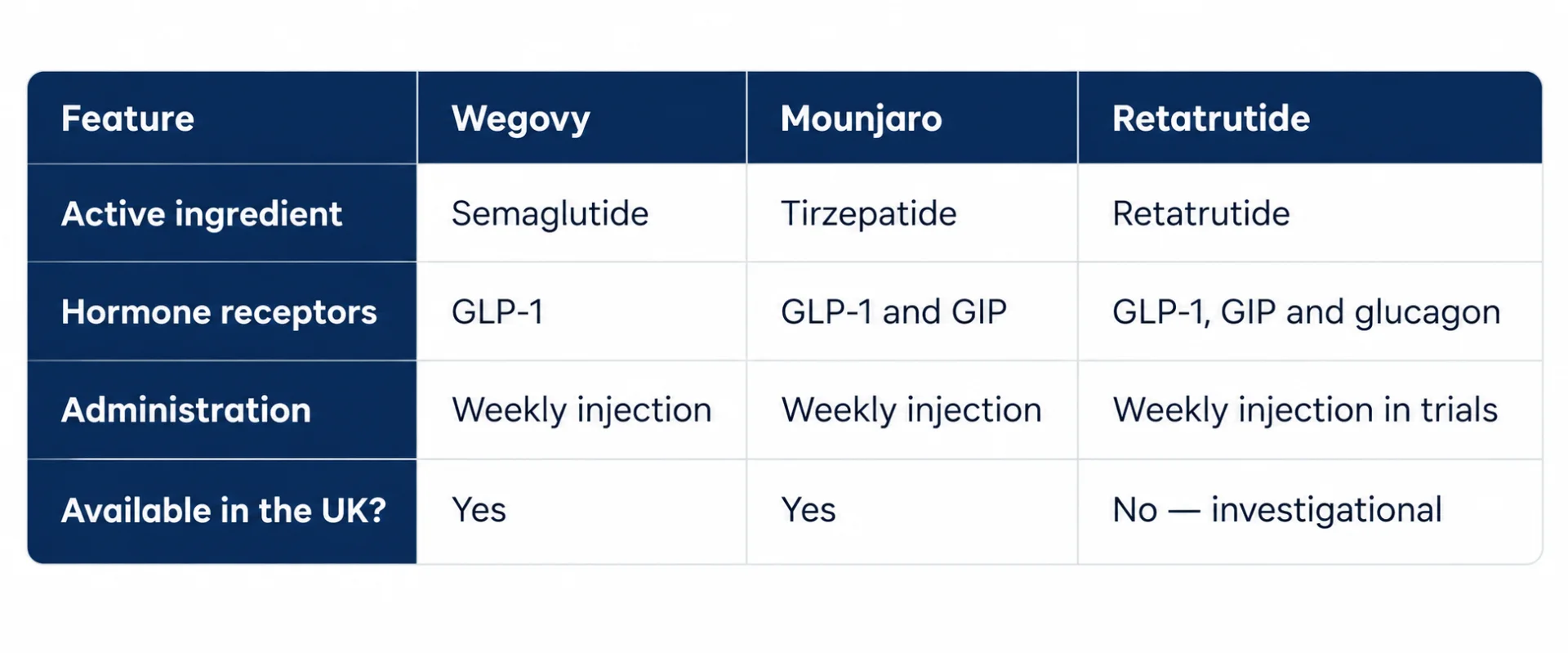
Retatrutide has shown particularly substantial weight loss in clinical trials.
Does that mean it's better than Mounjaro?
Not necessarily.
Results from separate clinical trials cannot be compared directly because participants, doses, study durations and other factors may differ.
Mounjaro and Wegovy have established clinical evidence and are already licensed for weight management in the UK. Retatrutide still requires regulatory assessment.
For patients, choosing a treatment involves far more than looking at the highest percentage of weight lost. Tolerability, medical history, treatment goals and long-term sustainability all matter.
What are the possible side effects of retatrutide?
As with other treatments that act on GLP-1 receptors, digestive side effects are among the most commonly reported in retatrutide trials.
These include:
- Nausea and vomiting
- Diarrhoea
- Constipation
- Reduced appetite
Some participants have also reported changes in skin sensation, such as tingling or unusual sensitivity.
Side effects can be more noticeable when treatment begins or doses increase. Although many reported effects have been mild or moderate, some participants have stopped treatment because of adverse effects.
Researchers are continuing to assess safety, including less common and longer-term risks.
An important point: retatrutide does not yet have an approved UK prescribing information leaflet, so its final warnings, precautions and recommended doses are not established.
When will retatrutide be available in the UK?
As of October 2026, retatrutide is not licensed or available as a routine prescription treatment in the UK.
Although several Phase 3 studies have reported positive results, the medicine must still complete the relevant regulatory processes.
Eli Lilly has indicated that it plans to submit retatrutide for US regulatory approval in the first quarter of 2027.
There is currently no confirmed UK launch date.
If retatrutide receives UK approval, its licensed indications, prescribing criteria and availability will depend on the outcome of the regulatory review.
Until then, any claims that the medicine is about to become available in UK pharmacies should be treated cautiously.
Can you buy retatrutide online now?
You may have seen websites or social media sellers offering retatrutide injections, sometimes described as research peptides.
These products should not be confused with the medicine being investigated in regulated clinical trials.
The MHRA has warned about unlicensed weight-loss injections and the risks associated with unauthorised suppliers.
Products sold through these channels may contain incorrect doses, contaminants or substances that have not undergone appropriate quality testing.
Retatrutide should not be purchased from unregulated online sellers or used outside an authorised clinical trial.
Will retatrutide be suitable for weight maintenance?
An important question in weight management is what happens after someone reaches their goal weight.
For many people, maintaining weight loss can be just as challenging as losing weight in the first place.
Researchers are investigating retatrutide for weight management, including its potential role in maintaining weight reduction.
However, we do not yet have enough evidence to establish how it should be used for long-term maintenance in routine clinical practice.
At Pharmulous, we believe weight management should be viewed as a long-term journey rather than a short-term course of treatment.
That means looking beyond the number on the scales and considering appetite control, nutrition, muscle health, quality of life and whether a treatment remains appropriate over time.
This is an area where ongoing research into medicines such as retatrutide will be particularly interesting.
Should you wait for retatrutide?
It's understandable to be curious about a medicine producing such promising trial results.
However, if you're considering medical weight management, there's no need to assume that waiting for the newest treatment will necessarily lead to a better outcome.
Several established treatments are already available in the UK, and the right approach depends on your individual circumstances.
A medicine that works extremely well for one person may not be suitable for another.
There is also no evidence-based switching schedule from Mounjaro or Wegovy to retatrutide for routine UK prescribing.
Making changes to an existing treatment based on early research or information shared online is not advisable without appropriate clinical guidance.
The Pharmulous stance
At Pharmulous, we're encouraged by the progress being made in obesity medicine, particularly the growing recognition that weight management is complex and often requires ongoing support.
But successful treatment is about more than achieving the greatest possible weight loss.
Our approach has always been to focus on safe, individualised and sustainable weight management, recognising that patients have different starting points, medical histories and long-term goals.
That includes supporting patients who are starting their journey, those changing treatments and those who have already reached their target weight and are working to maintain it.
We'll continue following retatrutide research as further evidence becomes available.
For now, the priority remains helping patients make informed decisions using treatments that have been appropriately assessed and authorised.
Frequently asked questions
Is retatrutide stronger than Mounjaro?
Retatrutide targets three hormone receptors compared with Mounjaro's two, and it has produced substantial weight loss in clinical trials. However, this does not establish that it is more effective or suitable for every patient.
Is retatrutide approved in the UK?
No. As of October 2026, retatrutide remains investigational and is not licensed for routine prescribing in the UK.
Is retatrutide a tablet or an injection?
Retatrutide is being investigated as a once-weekly injection. It is not currently an approved weight-loss tablet.
How much will retatrutide cost in the UK?
There is no confirmed UK price. Pricing will depend on future regulatory and commercial decisions.
Can I switch from Mounjaro to retatrutide?
There is no current approved routine switching pathway in the UK. Any future switching recommendations would need to consider licensing, clinical evidence and individual patient safety.
References
- Eli Lilly and Company. TRIUMPH-1 Phase 3 results and improvements in weight and associated conditions. June 2026.
- Eli Lilly and Company. TRIUMPH-2 and TRIUMPH-3 Phase 3 results. July 2026.
- Bellido V, et al. Retatrutide in adults with obesity and type 2 diabetes (TRIUMPH-2). The Lancet. October 2026. DOI: 10.1016/S0140-6736(26)01861-1.
- Jastreboff AM, et al. Triple–Hormone-Receptor Agonist Retatrutide for Obesity — A Phase 2 Trial. New England Journal of Medicine. 2023.
- MHRA. Unlicensed weight-loss medicines and counterfeit product enforcement. October 2025.
- MHRA, ASA and GPhC. Warning on promoting unlicensed weight-management medicines. June 2026.
Check out similar articles

Dr Amel Imam - 7th October 2026
Oral Semaglutide and Heart Health: Does the New Research Apply...

Dr Amel Imam - 7th October 2026
Mounjaro, Wegovy and Surgery: What New UK Research Says About...

Dr Amel Imam - 2nd October 2026
Switching From Mounjaro or Wegovy Injections to Wegovy Tablets:...

Dr Amel Imam - 30th September 2026
Is 8 Hours of Sleep Really Necessary? New Research on REM, Deep...

Dr Amel Imam - 30th September 2026
Can You Use Vaginal Oestrogen Long Term?

Dr Amel Imam - 29th September 2026

