
- >
- Blog >
- Can You Use Vaginal Oestrogen Long Term?

If vaginal dryness, irritation or discomfort during sex continue after menopause, you may wonder whether vaginal oestrogen is something you can only use for a short period or whether it can be continued long term.
For many people, vaginal oestrogen can be used long term and for as long as it is needed to control symptoms. NICE recommends continuing treatment for as long as needed to relieve symptoms, with regular review to ensure it remains appropriate and effective.
Because genitourinary symptoms of menopause can be chronic and progressive, stopping treatment may mean symptoms return.
What is vaginal oestrogen used for?
Vaginal oestrogen is a form of local HRT used to treat symptoms caused by reduced oestrogen levels during and after menopause.
It can help relieve:
- Vaginal dryness
- Burning, itching or irritation
- Vaginal soreness
- Discomfort or pain during sex
- Reduced lubrication
- Some urinary symptoms associated with menopause
These symptoms are often referred to as genitourinary syndrome of menopause, or GSM.
GSM can affect the vulva, vagina, bladder and urethra. The British Menopause Society describes GSM as a chronic and progressive condition, meaning symptoms can persist or become more troublesome over time.
Can you use vaginal oestrogen long term?
Yes. Vaginal oestrogen can usually be continued for as long as you need it to control your symptoms.
Unlike systemic HRT, there is no recommendation to stop low-dose vaginal oestrogen after a set number of years simply because you have been using it for a long time. NICE recommends continuing vaginal oestrogen for as long as needed to relieve symptoms.
Your treatment should still be reviewed regularly to make sure it remains appropriate, effective and well tolerated.
Why might you need vaginal oestrogen long term?
Menopause causes a long-term reduction in oestrogen. Vaginal and urinary symptoms can therefore continue even when other menopause symptoms, such as hot flushes and night sweats, have improved.
Vaginal oestrogen helps support the vaginal tissues while it is being used. If treatment is stopped, the underlying reduction in oestrogen remains and symptoms may gradually return.
This means vaginal oestrogen is often ongoing symptom management rather than a short course of treatment. NICE specifically advises that women should be aware that symptoms often return when vaginal oestrogen is stopped.
How long can you use different types of vaginal oestrogen?
Vaginal oestrogen is available in several formulations, including tablets, pessaries, creams, gels and vaginal rings.
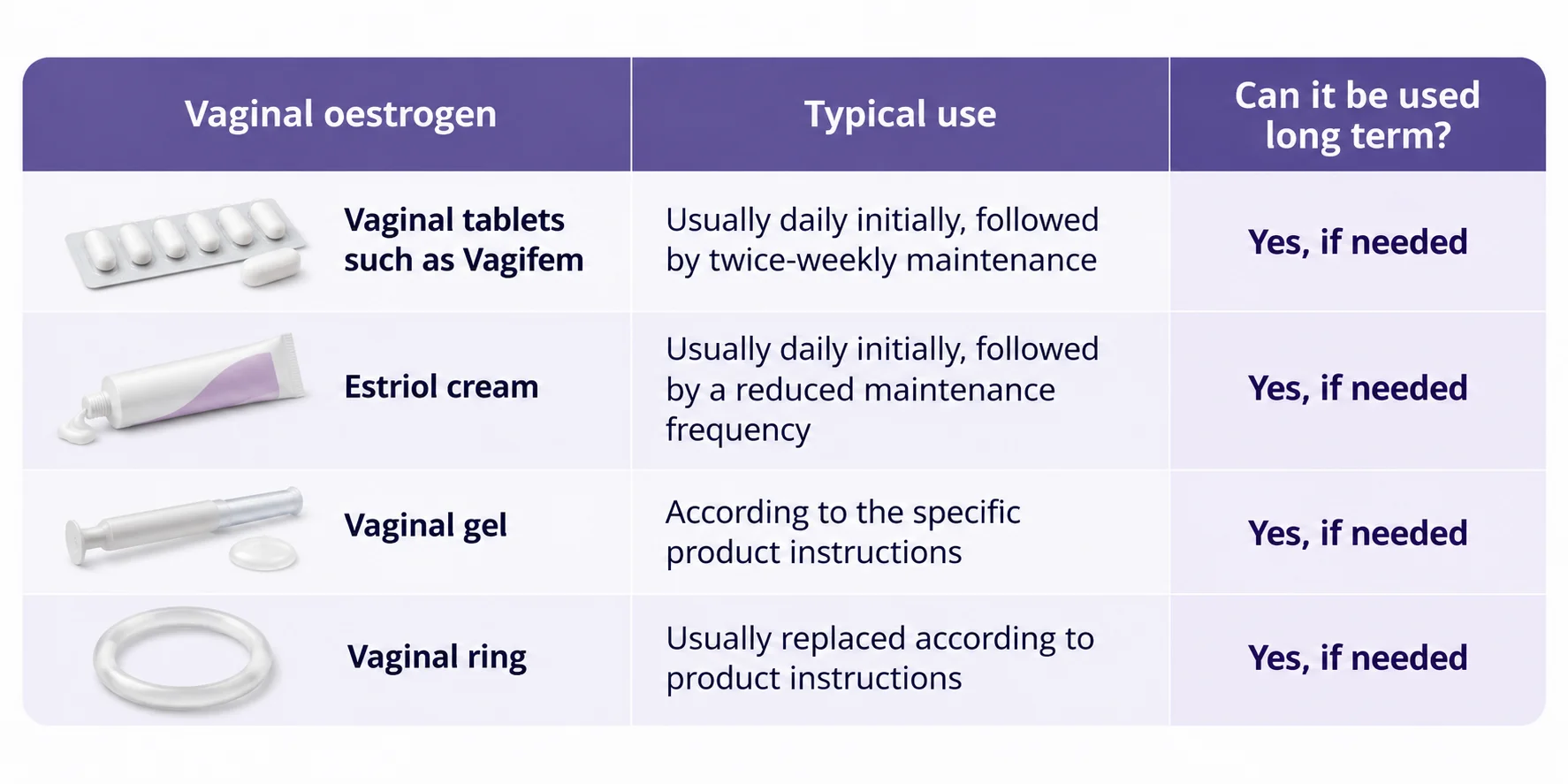 The exact dose and frequency depend on the specific product. Always follow the instructions for your prescribed treatment rather than assuming different products can be used in the same way.
Is long-term vaginal oestrogen safe?
Vaginal oestrogen uses a low dose designed to work mainly in the vaginal tissues. Only a small amount is absorbed into the bloodstream compared with systemic HRT. NICE considers serious adverse effects to be rare.
Research also provides reassurance about long-term use. A large Danish registry study found that increasing duration and intensity of vaginal estradiol tablet use was not associated with an increased rate of breast cancer compared with non-use.
However, it is important not to suggest that long-term safety has been studied as extensively as short-term treatment. A 2024 systematic review found that most clinical trials were relatively short, with few long-term data available. NICE has therefore identified safety beyond 12 months as an area where further research is needed.
For this reason, regular review remains important.
Do you need progesterone with long-term vaginal oestrogen?
Usually, no.
Low-dose vaginal oestrogen is generally not considered to require additional progesterone to protect the womb lining, even if you still have your womb.
This is different from systemic oestrogen HRT, such as oestrogen patches or gel. If you have a womb and use systemic HRT, you will usually need progesterone or another suitable progestogen for endometrial protection.
If you are already using systemic HRT, vaginal oestrogen can usually be added when vaginal or urinary symptoms continue despite treatment. NICE confirms that low-dose vaginal oestrogen does not need to be combined with systemic progestogen specifically for endometrial protection.
What happens if you stop vaginal oestrogen?
You may find that your symptoms return.
This does not necessarily mean that something is wrong with the treatment. It reflects the fact that the underlying reduction in oestrogen remains after menopause.
Research into what happens after stopping treatment suggests that some of the physical changes associated with GSM can return relatively quickly, supporting the role of vaginal oestrogen as an ongoing treatment rather than a short-term cure.
If you are thinking about stopping treatment, speak to your healthcare professional about whether this is appropriate and whether reducing the frequency may be suitable.
Do you need regular monitoring?
You do not usually need routine scans or monitoring simply because you are using low-dose vaginal oestrogen.
NICE does not recommend routine monitoring of endometrial thickness during treatment for genitourinary symptoms of menopause. However, your treatment should still be reviewed regularly to ensure it remains suitable and effective.
During a review, your healthcare professional can check whether:
- Your symptoms are controlled
- Your treatment is still suitable
- Your dose and frequency remain appropriate
- You are experiencing any side effects
- You need to continue treatment
When should you seek medical advice?
Speak to your healthcare professional if you experience:
- New or unexplained vaginal bleeding
- Heavy or persistent bleeding
- New or worsening pelvic pain
- Unusual vaginal discharge
- Symptoms that are not improving despite treatment
- New symptoms that you are concerned about
Any unexplained vaginal bleeding after menopause should be assessed rather than simply attributed to vaginal oestrogen.
You should also discuss vaginal oestrogen with your healthcare professional if you have a history of breast cancer or another oestrogen-sensitive cancer, particularly if you are taking an aromatase inhibitor. Individual circumstances and specialist advice may need to be considered.
Important points
- Vaginal oestrogen can be used long term and for as long as it is needed to control symptoms. There is no fixed time limit for low-dose vaginal oestrogen.
- Because GSM can be a long-term condition, symptoms may return when treatment is stopped. Continuing treatment can help maintain the benefits and manage ongoing vaginal and urinary symptoms.
- The important thing is to use the lowest effective dose and frequency that controls your symptoms, follow your product instructions and have your treatment reviewed regularly.
- If you are experiencing vaginal dryness, irritation or discomfort and want to explore whether vaginal oestrogen may be suitable for you, complete a confidential Pharmulous assessment form.
How can Pharmulous help?
At Pharmulous, you can complete a confidential online assessment without needing to arrange a face-to-face appointment.
When completing your Pharmulous assessment form, you can provide information about your medicines, health and treatment needs confidentially.
If you're considering vaginal oestrogen, our prescribers can review your clinical information to determine whether treatment is appropriate for you and provide relevant advice as part of the prescribing process.
Complete your confidential Pharmulous assessment today to see how we can help.
References
- NICE. Menopause: identification and management. NICE guideline NG23.
- NHS. How and when to use vaginal oestrogen.
- NHS: About vaginal oestrogen
- NHS Somerset Integrated Care Board. Genitourinary Syndrome of the Menopause. Dr Juliet Balfour, 12 November 2024.
- British Menopause Society. Genitourinary Syndrome of Menopause: Consensus Statement. Reviewed November 2025. (British Menopause Society)
- Danan ER, et al. Hormonal Treatments and Vaginal Moisturizers for Genitourinary Syndrome of Menopause: A Systematic Review. Annals of Internal Medicine. 2024;177(10):1400–1414.
- Kolokythas A, et al. Impact of vaginal estriol on serum hormone levels: a systematic review. Climacteric.
- Santen RJ, et al. Sustainability of vaginal estrogens for genitourinary syndrome of menopause: a systematic review.
- Cold S, et al. Association of vaginal oestradiol and the rate of breast cancer in Denmark: registry based, case-control study, nested in a nationwide cohort. BMJ. 2024.
Check out similar articles

Dr Amel Imam - 2nd October 2026
Switching From Mounjaro or Wegovy Injections to Wegovy Tablets:...

Dr Amel Imam - 30th September 2026
Is 8 Hours of Sleep Really Necessary? New Research on REM, Deep...

Dr Amel Imam - 29th September 2026
Vagifem Not Working Yet? When Should Symptoms Improve?

Dr Amel Imam - 29th September 2026
How Often Should I Weigh Myself? A Guide for Mounjaro, Wegovy...

Dr Amel Imam - 28th September 2026
Mounjaro and Breastfeeding: What Has Changed in 2026?

Dr Amel Imam - 28th September 2026

